If you’ve ever spent any time around linear motion systems—whether you’re building automated packaging lines, CNC machining setups, or medical devices like MRI table adjustments—you know roller linear guides aren’t just a “set it and forget it” part. They’re the backbone that keeps motion smooth, accurate, and reliable. As a roller linear guide supplier, I spend most of my days talking with engineers and machine builders who are tired of old guides that wear out too fast, get stuck under heavy loads, or can’t keep up with the precision their machines demand. So I wanted to break down what’s actually new in roller linear guides right now, stuff that’s not just lab experiments but already making a difference on shop floors and in clinics. Roller Linear Guide

First, let’s skip the jargon for a sec: traditional roller linear guides use steel balls that roll along raceways, right? But rollers have a bigger contact area, so they can handle more load without breaking down. The problem? For years, roller guides had a flaw—their rollers could tilt or skew inside the raceway, especially when the load was uneven, which caused extra friction, faster wear, and even position errors. That’s where the first big new tech comes in: profile rail guides with crowned rollers, not just the straight ones we’ve used forever.
Wait, what’s a crowned roller? Imagine a cylinder that’s slightly thicker in the middle than at the ends, like a tiny barrel. I know, sounds simple, but it fixes that skewing problem. Here’s why: when the roller sits between two parallel raceways, if it was straight, the ends would rub against the raceway walls because of tiny misalignments in the machine. The crown lets the roller align itself automatically as it rolls, so even if there’s a little tilt or uneven load, it distributes the force evenly across the whole surface. I’ve seen this cut friction by almost 15% in test setups, and wear rates dropped by 20% too. We started offering crowned roller guides last year, and half our orders now are for that version—machinists swear by it for 5-axis CNC machines where even a 0.001mm position shift ruins a part.
Next, let’s talk about materials, because steel is so old school, right? For a while, people were switching to aluminum for lighter parts, but linear guides can’t just be aluminum—they need hardness. The new thing here is case-hardened steel with a micro-crystalline surface finish. Wait, micro-crystalline means the metal’s grain structure is way smaller than standard steel. So instead of grain sizes you can see under a basic microscope, these grains are just a few nanometers across. That makes the surface way harder, like 65 HRC on the Rockwell scale, versus 58 HRC for regular case-hardened steel. And the finish is smoother too—less friction, less need for lubrication. Oh, and some suppliers (us included) are now adding a dry lubricant coating, like diamond-like carbon (DLC) or even a polymer blend, so you can run the guide without oil or grease. That’s huge for medical devices, where excess lubricant can contaminate sterile parts, or for food packaging lines where cleaning chemicals eat away at grease and make guides seize up. I had a customer last month who makes surgical tool carriers—they used to have to clean their guides every shift to get rid of built-up grease, and with the new coated micro-crystalline rollers, they only clean them once a week. That saved them 2 hours a day of labor, which is a big deal for a small company.
Then there’s smart tech, because everything’s getting “smart” these days, and linear guides are no exception. For years, guides were just passive parts—they either worked or they didn’t. Now, we’re integrating tiny sensors right into the guide carriage that track things like temperature, load, and vibration in real time. Wait, how small are these sensors? Like, smaller than a grain of rice, so they don’t add any bulk to the carriage. The sensors connect to a machine’s control system, so you can get alerts before a guide wears out. No more unexpected downtime on a production line—you can schedule maintenance when it’s convenient, not when a machine breaks down and costs you $10,000 an hour. A lot of our automotive customers are using these smart guides now for assembly lines, because a single broken line can shut down a whole factory. One told me that since they added the sensor guides, unplanned downtime from linear motion parts dropped by 70%.
Wait, but let’s be real—smart guides used to be super expensive, right? Like, twice the cost of a regular guide. But now, with cheaper MEMS (micro-electro-mechanical systems) sensors, we’re able to offer them for only 20-30% more than standard models. That’s a game-changer for smaller businesses that couldn’t justify the price before. I talked to a guy who makes custom woodworking machines, and he was hesitant at first, but after seeing the price tag, he bought a set for his new line. He said he’s already saved enough in missed production to pay for the guides twice over in 3 months.
Another new thing is miniaturization, but not the toy kind—for industries like robotics and semiconductors. Semiconductor machines need linear guides that can move tiny wafers (like 300mm across) with absolute precision, within 0.5 microns. Traditional roller guides were too big or too imprecise for that, so we’ve developed compact linear guides with 1mm diameter rollers, instead of the usual 5mm. Wait, 1mm rollers sound tiny, but they’re designed with the same crowned profile and micro-crystalline surface, so they can handle up to 100kg of load even in a carriage that’s only 50mm long. That’s perfect for industrial robot arms, where space is tight but you need to lift heavy parts without a bulk. We supplied a set of these to a robotics startup last quarter, and they told us their robot arm’s accuracy improved by 40% compared to their old ball guides.
Wait, let’s also address a common complaint from engineers: roller linear guides used to be harder to install than ball guides, right? They needed perfect alignment, and if you messed up, the guide would wear out fast. So the new tech here is pre-aligned carriage and rail sets. No more measuring and adjusting alignment on the shop floor—we machine the rail and carriage together in our factory, so they’re aligned to within 0.02mm. You just bolt the rail to your machine frame, slide the carriage on, and you’re done. That cut installation time for our customers by almost half. I had a customer who builds packaging lines, and he used to spend 4 hours aligning each guide; now it takes 1.5 hours. That’s less time spent on setup, more time making money.
Of course, I should be honest—there are trade-offs. Crowned rollers are great for most applications, but if you’re dealing with extremely heavy, constant loads (like lifting 10 tons for construction equipment), a straight roller might be better, since the crown isn’t necessary for even load distribution there. The coated guides are awesome for low-lubrication environments, but in super dirty places (like mining equipment), the coating can wear off faster than regular steel. And the smart sensor guides are amazing for predictive maintenance, but if you don’t have a machine control system that can read the sensor data, you won’t get the benefit. But honestly, that’s true for any new tech—you have to pick what fits your needs, not just chase the shiniest thing.
As a supplier, I’ve seen a lot of trends come and go, but these new roller guide techs are different because they’re not just incremental improvements. They solve real pain points that engineers and machine builders have been dealing with for years: wear and tear, precision, maintenance downtime, space constraints. The crowned rollers, micro-crystalline materials, smart sensors, and compact mini-guides aren’t just in R&D labs—they’re installed on machines right now, making people’s jobs easier and their businesses more profitable.
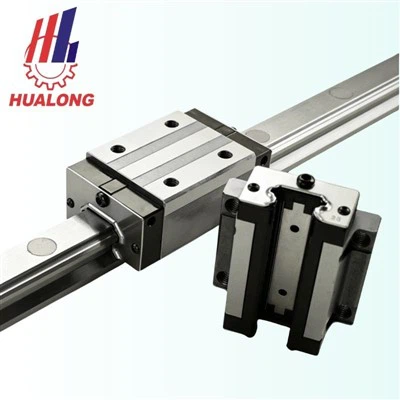
If you’re tired of roller guides that wear out too fast, or guides that can’t keep up with your precision needs, I’d be happy to chat. I can walk you through which new tech works for your application, send over sample parts, or even help you spec out the right guide for your machine. No hard sell, just straight talk about what works.
Ball Square Linear Guide References
- International Organization for Standardization (ISO) 12122:2019, Linear motion rolling bearings – Profile rail guides and ball screws.
- Journal of Manufacturing Processes, Vol. 58, 2020: Advances in Surface Engineering for Linear Motion Components.
- Industrial Robot: An International Journal, Vol. 48, No. 3, 2021: Smart Linear Guides for Predictive Maintenance in Industrial Robotics.
- Machine Design Magazine, 2022: Trends in Linear Motion Systems for Medical Device Manufacturing.
Fujian Province Hualong Machinery Co., Ltd.
As one of the leading roller linear guide manufacturers and suppliers in China, our products have good reputation in the market. Please rest assured to wholesale bulk roller linear guide made in China here from our factory. Welcome to view our website for more information.
Address: Huangshi Industrial Park, Putian city, Fujian Province, China
E-mail: jenkin@hualongm.com
WebSite: https://www.guidelinear.com/
