As a provider in the field of flange facers, I often encounter customers who have unique requirements when it comes to flange facing. One question that has been popping up more frequently is whether a flange facer can be utilized for facing flanges with irregular shapes. In this blog post, I’d like to dive into this topic and share my insights based on years of experience in the industry. Flange Facer
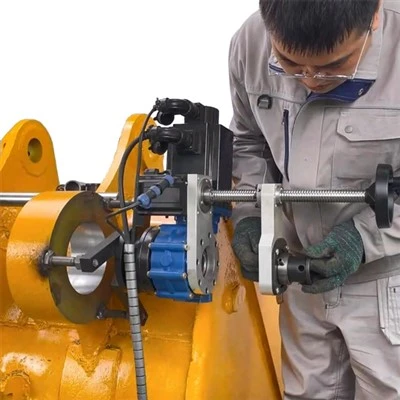
Understanding Flange Facers and Their Traditional Use
Before we discuss the application on irregular – shaped flanges, let’s first understand what a flange facer is and its common uses. A flange facer is a precision machine tool designed to machine the surface of a flange. The primary purpose of facing a flange is to create a smooth, flat, and perpendicular surface. This is crucial because a properly faced flange ensures a leak – free seal when it is connected to another flange, pipe, or valve in a piping system.
In traditional industrial settings, flange facers are commonly used for facing standard – shaped flanges, such as those with circular shapes, which are prevalent in most piping systems. These standard flanges have well – defined dimensions and shapes, and they follow industry – recognized standards. For instance, ASME (American Society of Mechanical Engineers) standards specify a wide range of flange dimensions, including diameter, bolt hole patterns, and face finishes. Standard – shaped flanges are relatively easy to machine because flange facers are typically programmed and calibrated to work with these well – known geometries.
Challenges with Irregular – Shaped Flanges
Irregular – shaped flanges deviate from the standard circular or rectangular shapes, presenting unique challenges in the flange – facing process. These flanges might have non – circular perimeters, such as oval, triangular, or custom – designed odd shapes. They could also have uneven surfaces, inconsistent thickness, or complex internal structures.
One of the first challenges is the lack of a standardized machining path. With standard flanges, the machining process can be automated because the toolpaths are well – established. However, for irregular – shaped flanges, the machine operator needs to create a custom machining path that accommodates the unique shape of the flange. This requires a high level of skill and experience to ensure that every part of the flange surface is machined accurately.
Another challenge is the material removal rate. Irregular – shaped flanges may have thinner or thicker sections in different areas. If the material removal rate is not adjusted properly, it can lead to uneven machining, causing problems in the final connection. For example, if a thick section is machined too quickly, it may result in a rough surface finish, while a thin section may be over – machined and become too thin, compromising the structural integrity of the flange.
Can a Flange Facer be Used for Irregular – Shaped Flanges?
The short answer is yes, a flange facer can be used for facing flanges with irregular shapes, but it comes with certain conditions and considerations.
Adaptability of Flange Facers
Modern flange facers are designed with a certain degree of adaptability. Many flange facers are equipped with advanced control systems that allow for custom programming. These systems can take into account the unique shape of an irregular flange and generate a specific toolpath for machining. For example, some CNC (Computer Numerical Control) flange facers can be programmed with CAD (Computer – Aided Design) models of the irregular flange. The machine then follows the instructions in the CAD model to machine the flange surface precisely.
Tooling Selection
The choice of tooling is also crucial when facing irregular – shaped flanges. Different shapes may require different types of cutting tools. For instance, for flanges with sharp corners or complex curves, a smaller – diameter cutting tool may be needed to ensure that the machine can reach all areas of the flange surface. Additionally, the tool material needs to be selected based on the material of the flange. Harder flange materials, such as stainless steel or alloy steel, may require carbide – tipped cutting tools to achieve a smooth finish and a reasonable tool life.
Operator Skills
The role of the machine operator cannot be underestimated. When working with irregular – shaped flanges, an experienced operator is essential. The operator needs to understand the unique characteristics of the flange, interpret the custom – programmed machining path, and make real – time adjustments during the machining process. They also need to have knowledge of material properties and cutting parameters to ensure that the flange is machined correctly without causing damage.
Case Studies of Successful Irregular – Flange Facing
Over the years, we have faced numerous challenges when dealing with irregular – shaped flanges for our customers. Many of these projects involved custom – designed flanges for specialized applications, such as in the aerospace and renewable energy industries.
In one case, we were approached by a customer in the aerospace industry who needed to face an oval – shaped flange made of a high – strength aluminum alloy. The flange had a complex internal structure and required a very precise surface finish for proper sealing. Using our advanced CNC flange facer, we were able to program the machine to follow the oval contour of the flange. Our experienced operators carefully selected the appropriate cutting tools and adjusted the cutting parameters to ensure that the material removal rate was consistent across the entire flange surface. After a series of machining operations, we successfully achieved the required surface finish and dimensions, meeting the customer’s strict quality standards.
Another example is from the renewable energy sector. A customer needed a triangular – shaped flange made of carbon steel to be faced for a solar power project. The challenge here was to maintain the flatness of the flange surface and ensure that the edges were machined at the correct angles. Our team used a combination of custom tooling and precise programming to tackle this task. We were able to complete the project on time, demonstrating that we can effectively handle flanges with non – standard shapes.
Benefits of Using a Flange Facer for Irregular – Shaped Flanges
Despite the challenges, using a flange facer for irregular – shaped flanges offers several benefits.
Precision and Quality
Flange facers are designed to provide high – precision machining. When used correctly for irregular – shaped flanges, they can ensure that the surface finish, flatness, and perpendicularity of the flange meet the required specifications. This high – quality machining is essential for maintaining the integrity of the piping or connection system, preventing leaks and ensuring the long – term reliability of the equipment.
Cost – Effectiveness
In some cases, machining irregular – shaped flanges with a flange facer can be more cost – effective than other methods. Instead of using manual machining or complex multi – step processes, a flange facer can often complete the machining in a single setup. This reduces labor costs, machining time, and the risk of errors associated with multiple setups.
Customization
Flange facers allow for a high degree of customization. By using advanced programming and tooling options, we can machine flanges to meet the unique requirements of each customer. This flexibility is especially valuable in industries where custom – designed components are common.
Conclusion and Call to Action

In conclusion, a flange facer can indeed be used for facing flanges with irregular shapes. With the right equipment, tooling, and operator skills, it is possible to achieve high – quality results for even the most complex flange geometries.
Boring Welding If you are in the market for flange facing solutions, whether for standard or irregular – shaped flanges, we are here to help. Our team of experts has extensive experience in handling a wide range of flange – facing challenges. We can provide customized solutions based on your specific requirements and ensure that you receive a high – quality product that meets or exceeds your expectations. Contact us today to discuss your flange – facing needs and start a procurement conversation.
References
- ASME Standards for Pipe Flanges and Flanged Fittings
- Machinery’s Handbook, 31st Edition (contains comprehensive information on machining processes and tool selection)
- Journal of Manufacturing Technology Management (contains research articles on advanced machining techniques and applications in the industry)
Shangqiu JDA Machinery Technology Co., Ltd.
With abundant experience, we are one of the most professional flange facer manufacturers and suppliers in China. We warmly welcome you to buy cheap flange facer for sale here from our factory. Quality products and reasonable price are available.
Address: No. 55 Pingyuan Middle Road, Liangyuan District, Shangqiu, Henan, China
E-mail: sales@jdamachines.com
WebSite: https://www.jdamachines.com/
